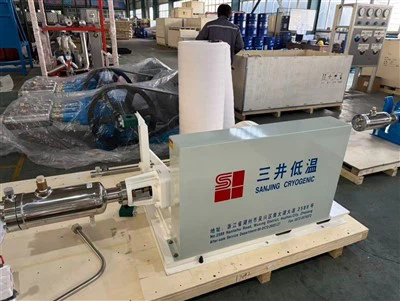


Insulation materials play a crucial role in the performance and efficiency of a Cryogenic Pump Skid. As a supplier of Cryogenic Pump Skids, I understand the importance of selecting the right insulation materials to ensure optimal operation in extremely low - temperature environments. In this blog, we will explore the various insulation materials commonly used for Cryogenic Pump Skids.
Why Insulation is Essential for Cryogenic Pump Skids
Cryogenic Pump Skids are designed to handle fluids at very low temperatures, often below -150°C. Without proper insulation, these systems would experience significant heat ingress. Heat ingress can lead to several problems, such as vaporization of the cryogenic fluid, which can cause cavitation in the pump, reduced pumping efficiency, and increased energy consumption. Moreover, it can also pose safety risks due to the potential for rapid expansion of the vaporized fluid.
Types of Insulation Materials
Perlite
Perlite is a popular insulation material for Cryogenic Pump Skids. It is a volcanic glass that has been expanded by heating. Perlite has excellent insulation properties due to its low thermal conductivity. Its porous structure traps air, which acts as an insulator.
One of the advantages of perlite is its relatively low cost. It is also lightweight, which is beneficial for the overall weight of the Cryogenic Pump Skid. However, perlite can be dusty, and proper handling is required during installation to avoid inhalation risks. Additionally, it may settle over time, which can reduce its insulation effectiveness.
When using perlite for insulation, it is often filled into the space around the cryogenic components in a loose - fill form. This allows it to conform to the shape of the equipment. Some Cryogenic Pump Skids use a double - walled design, with perlite filled in the annular space between the inner and outer walls. You can learn more about our Cryogenic Pump Skid that may utilize perlite insulation.
Polyurethane Foam
Polyurethane foam is another commonly used insulation material. It is a synthetic polymer that can be sprayed or poured into place. Polyurethane foam has a high R - value (a measure of thermal resistance), which means it provides excellent insulation.
One of the key advantages of polyurethane foam is its ability to form a seamless and air - tight insulation layer. This helps to prevent heat transfer through air leakage. It also adheres well to various surfaces, which makes it suitable for insulating complex - shaped components in the Cryogenic Pump Skid.
However, polyurethane foam has some limitations. It may degrade over time when exposed to certain chemicals or high - energy radiation. Also, its installation requires specialized equipment and trained personnel. Our Pump Skid with Valves may be insulated with polyurethane foam to ensure efficient operation.
Vacuum Insulation Panels (VIPs)
Vacuum Insulation Panels are a high - performance insulation solution for Cryogenic Pump Skids. They consist of a core material, usually a porous silica or fiberglass, enclosed in an air - tight envelope from which the air has been evacuated.
The main advantage of VIPs is their extremely low thermal conductivity. They can provide much better insulation than traditional insulation materials in a much thinner profile. This is particularly useful when space is limited in the Cryogenic Pump Skid.
However, VIPs are relatively expensive compared to other insulation materials. They are also fragile, and any damage to the envelope can cause a loss of the vacuum, which significantly reduces their insulation performance. Despite these drawbacks, VIPs are becoming more popular in applications where high - efficiency insulation is required.
Fiberglass Insulation
Fiberglass insulation is made from fine glass fibers. It is a well - known insulation material with a long history of use in various industries. Fiberglass has good thermal insulation properties and is relatively inexpensive.
It is available in different forms, such as batts, blankets, and loose - fill. Fiberglass insulation is easy to install and can be cut to fit the specific requirements of the Cryogenic Pump Skid. However, like perlite, it can be irritating to the skin, eyes, and respiratory system, so proper protective equipment is necessary during installation.
Fiberglass insulation may not be as effective as some of the other materials in extremely low - temperature applications. But it can be used in combination with other insulation materials to provide additional insulation in less - critical areas of the Cryogenic Pump Skid. Our Reciprocating Pump Skid may incorporate fiberglass insulation in some parts of its design.
Factors to Consider When Selecting Insulation Materials
When choosing insulation materials for a Cryogenic Pump Skid, several factors need to be considered.
Thermal Conductivity
The thermal conductivity of the insulation material is a critical factor. A lower thermal conductivity means better insulation performance. Materials with low thermal conductivity can minimize heat transfer from the surrounding environment to the cryogenic fluid, reducing energy consumption and improving the efficiency of the pump skid.
Cost
Cost is always an important consideration. While high - performance insulation materials like VIPs may offer excellent insulation, their high cost may not be feasible for all applications. On the other hand, more affordable materials like perlite and fiberglass may be suitable for less - demanding applications or where cost - effectiveness is a priority.
Space Requirements
The available space in the Cryogenic Pump Skid is also a factor. If space is limited, materials like VIPs, which can provide high - performance insulation in a thin profile, may be a better choice. In contrast, materials like perlite or fiberglass, which may require more space, may not be suitable in such cases.
Chemical Compatibility
The insulation material must be compatible with the cryogenic fluid and any other chemicals present in the system. Some materials may react with certain chemicals, leading to degradation of the insulation and potential damage to the equipment.
Installation and Maintenance
The ease of installation and maintenance of the insulation material is another important consideration. Materials that are easy to install, such as polyurethane foam or fiberglass batts, can reduce installation time and labor costs. Additionally, materials that require minimal maintenance, such as VIPs (if properly protected), can save long - term operational costs.
Conclusion
Selecting the right insulation materials for a Cryogenic Pump Skid is a complex decision that depends on various factors. Each insulation material has its own advantages and limitations, and the choice should be based on the specific requirements of the application, including thermal performance, cost, space availability, chemical compatibility, and ease of installation and maintenance.
As a Cryogenic Pump Skid supplier, we have extensive experience in selecting and using different insulation materials to ensure the best performance of our products. Whether you need a high - efficiency insulation solution for a demanding application or a cost - effective option for a less - critical project, we can provide you with the right Cryogenic Pump Skid.
If you are interested in our Cryogenic Pump Skids or have any questions about insulation materials, we encourage you to contact us for a detailed discussion. Our team of experts is ready to assist you in finding the most suitable solution for your needs.


References
- "Handbook of Cryogenic Engineering" by D. R. Olson
- "Insulation Materials: Selection and Application" by R. M. Clift
- Industry standards and guidelines for cryogenic equipment insulation.