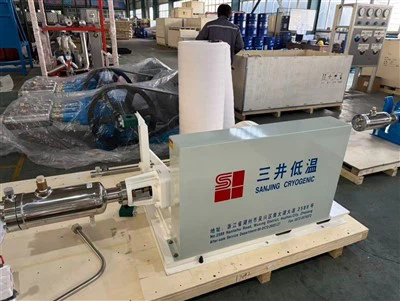


Self-priming centrifugal transfer pumps are a vital component in numerous industrial and commercial applications, offering an efficient and reliable solution for moving liquids from one location to another. As a leading supplier of Centrifugal Transfer Pump, I am often asked about how these pumps work. In this blog post, I will delve into the working principles of self-priming centrifugal transfer pumps, exploring their components, operation, and advantages.
Components of Self-Priming Centrifugal Transfer Pumps
Before we dive into how these pumps work, it's essential to understand their key components. A typical self-priming centrifugal transfer pump consists of the following parts:
- Impeller: The impeller is the heart of the pump. It is a rotating component with vanes that are designed to impart kinetic energy to the liquid. When the impeller rotates, it creates a centrifugal force that pushes the liquid outward from the center of the impeller.
- Volute: The volute is a spiral-shaped casing that surrounds the impeller. Its primary function is to convert the kinetic energy of the liquid into pressure energy. As the liquid is forced out of the impeller, it enters the volute, where the cross-sectional area gradually increases. This causes the velocity of the liquid to decrease, and the pressure to increase.
- Suction Pipe: The suction pipe is connected to the inlet of the pump. It is responsible for drawing the liquid into the pump. In a self-priming pump, the suction pipe must be filled with liquid before the pump can start operating.
- Discharge Pipe: The discharge pipe is connected to the outlet of the pump. It is used to deliver the liquid to its desired destination.
- Priming Chamber: The priming chamber is a crucial component in self-priming pumps. It is located above the impeller and is designed to hold a certain amount of liquid. This liquid is used to create a seal and prime the pump, allowing it to start pumping without the need for external priming.
Working Principle of Self-Priming Centrifugal Transfer Pumps
The operation of a self-priming centrifugal transfer pump can be divided into two main phases: the priming phase and the pumping phase.
Priming Phase
The priming phase is the initial stage of the pump's operation. Before the pump can start pumping, the priming chamber must be filled with liquid. This can be done manually or automatically, depending on the design of the pump.
Once the priming chamber is filled, the pump is started. As the impeller begins to rotate, it creates a vacuum in the suction pipe. This vacuum causes the liquid in the priming chamber to flow into the suction pipe and into the impeller. As the liquid enters the impeller, it is accelerated by the rotating vanes and is forced out of the impeller into the volute.
As the liquid is forced out of the impeller, it creates a low-pressure area at the inlet of the impeller. This low-pressure area causes more liquid to be drawn into the suction pipe from the source. As the liquid continues to flow into the pump, the air in the suction pipe is gradually displaced by the liquid. Once all the air has been removed from the suction pipe, the pump is primed and ready to start pumping.
Pumping Phase
Once the pump is primed, it enters the pumping phase. In this phase, the impeller continues to rotate, creating a continuous flow of liquid through the pump. As the liquid enters the impeller, it is accelerated by the rotating vanes and is forced out of the impeller into the volute.
In the volute, the kinetic energy of the liquid is converted into pressure energy. The pressure energy causes the liquid to flow through the discharge pipe and to its desired destination. The flow rate and pressure of the liquid can be adjusted by changing the speed of the impeller or by adjusting the size of the discharge pipe.


Advantages of Self-Priming Centrifugal Transfer Pumps
Self-priming centrifugal transfer pumps offer several advantages over other types of pumps, making them a popular choice in many applications. Some of the key advantages include:
- Self-Priming Capability: One of the main advantages of self-priming centrifugal transfer pumps is their ability to prime themselves. This eliminates the need for external priming devices, such as vacuum pumps or foot valves, which can be expensive and require additional maintenance.
- Versatility: Self-priming centrifugal transfer pumps can handle a wide range of liquids, including water, chemicals, and slurries. They can also be used in a variety of applications, such as water supply, irrigation, industrial processes, and wastewater treatment.
- Efficiency: These pumps are highly efficient, with a high flow rate and a relatively low power consumption. This makes them a cost-effective solution for many applications.
- Easy to Install and Maintain: Self-priming centrifugal transfer pumps are relatively easy to install and maintain. They have a simple design and few moving parts, which reduces the risk of breakdowns and makes them easy to repair.
Applications of Self-Priming Centrifugal Transfer Pumps
Self-priming centrifugal transfer pumps are used in a wide range of applications across various industries. Some of the common applications include:
- Water Supply: These pumps are commonly used in water supply systems to transfer water from wells, rivers, or storage tanks to homes, businesses, and industries.
- Irrigation: Self-priming centrifugal transfer pumps are widely used in irrigation systems to transfer water from water sources to fields and crops.
- Industrial Processes: In industrial processes, these pumps are used to transfer liquids such as chemicals, solvents, and oils. They are also used in processes such as filtration, mixing, and heating.
- Wastewater Treatment: Self-priming centrifugal transfer pumps are used in wastewater treatment plants to transfer wastewater from one treatment stage to another. They are also used to pump sludge and other solids from the treatment process.
Related Products
In addition to Centrifugal Transfer Pump, we also offer a range of related products, such as Carbon Dioxide Cryogenic Gear Pumps and High Flow Centrifugal Pump. These products are designed to meet the specific needs of our customers and are built to the highest standards of quality and reliability.
Conclusion
Self-priming centrifugal transfer pumps are a versatile and efficient solution for moving liquids in a wide range of applications. Their self-priming capability, high efficiency, and ease of installation and maintenance make them a popular choice among industrial and commercial users.
If you are in the market for a self-priming centrifugal transfer pump or any other related products, please do not hesitate to contact us. Our team of experts is ready to assist you in finding the right pump for your specific needs. We look forward to the opportunity to work with you and to provide you with the best possible products and services.
References
- Pump Handbook, Karassik, I. J., Messina, J. P., Cooper, P. E., & Heald, C. C. (2008).
- Centrifugal Pumps: Design and Application, Stepanoff, A. J. (1957).
- Self-Priming Pumps: Principles and Applications, Pump Engineering, Inc.