


Hey there! As a supplier of Pump Skids with Valves, I've been in the game for quite a while, and I've seen firsthand the unique challenges and requirements when it comes to handling cryogenic fluids. Cryogenic fluids, like liquid nitrogen, liquid oxygen, and liquid natural gas, are super cold, usually below -150°C (-238°F). That low temperature brings a whole set of special needs for the Pump Skid with Valves used to move these fluids around.
First off, let's talk about materials. The materials used in a Pump Skid with Valves for cryogenic fluids have to be able to handle the extreme cold without becoming brittle or losing their structural integrity. Metals like stainless steel are commonly used because they have good mechanical properties at low temperatures. For example, austenitic stainless steels, such as 304 and 316, are great choices. They can withstand the thermal shock that occurs when the cryogenic fluid comes into contact with the skid and valves. Non - metallic materials also play a role. Gaskets and seals need to be made from materials that can remain flexible at cryogenic temperatures. Teflon (PTFE) is a popular option as it has low friction, good chemical resistance, and can stay elastic even in the cold.
Another crucial requirement is insulation. Since cryogenic fluids are so cold, they tend to absorb heat from their surroundings. If the Pump Skid with Valves isn't properly insulated, the cryogenic fluid can start to warm up, turn into a gas, and cause all sorts of problems like pressure build - up and reduced efficiency. There are different types of insulation materials available. Perlite is a common one. It's a lightweight, granular material that provides good thermal insulation. Vacuum insulation is also used in some high - end applications. It creates a near - perfect barrier against heat transfer by removing the air between two layers of the skid or valve components.
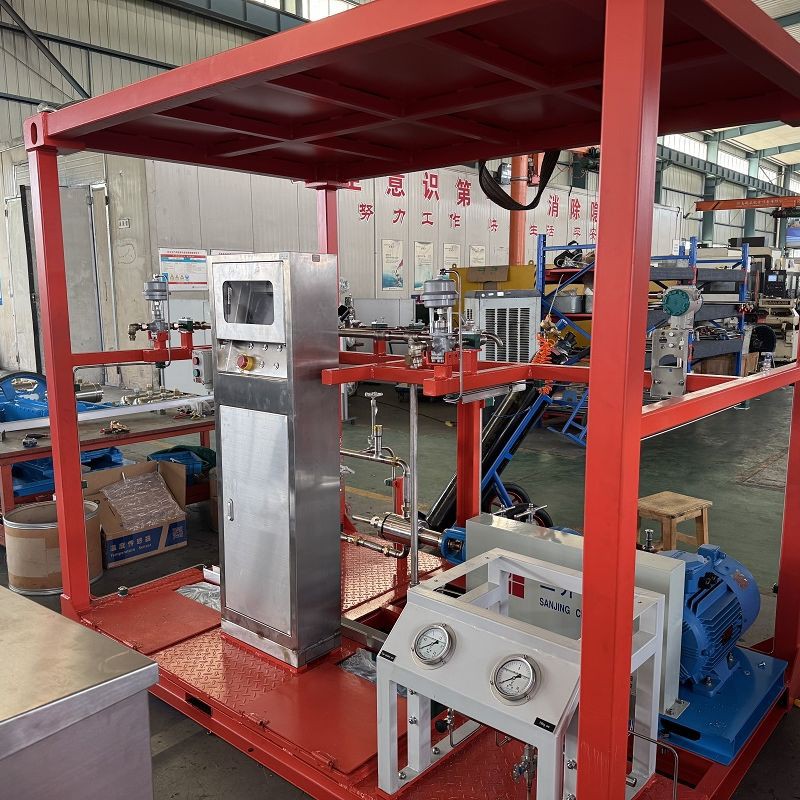
Now, let's consider the design of the Pump Skid with Valves. The layout needs to be carefully thought out to minimize heat transfer and pressure drops. The pumps and valves should be arranged in a way that allows for easy maintenance and inspection. For instance, having enough space around each component makes it easier for technicians to access and work on them. The piping should also be designed to handle the thermal contraction and expansion that occurs as the cryogenic fluid passes through. Flexible joints can be used to absorb these movements and prevent damage to the piping system.
When it comes to the pumps themselves, they need to be specifically designed for cryogenic service. A Cryogenic Reciprocating Pump Skid is a great option in many cases. These pumps are designed to handle the high pressures and low temperatures associated with cryogenic fluids. They use a reciprocating motion to move the fluid, which can be very efficient. The valves in the skid also have special requirements. They need to be able to open and close properly at cryogenic temperatures and seal tightly to prevent any leakage. Globe valves and ball valves are commonly used in cryogenic Pump Skids. Globe valves offer good flow control, while ball valves provide a fast - acting, tight - sealing solution.
Safety is always a top priority when dealing with cryogenic fluids. The Pump Skid with Valves should be equipped with safety features such as pressure relief valves. These valves are designed to open automatically if the pressure inside the skid or piping system gets too high, preventing any potential explosions or damage. Temperature sensors are also important. They can monitor the temperature of the cryogenic fluid and the components of the skid, alerting operators if there are any abnormal temperature changes.
In addition to the technical requirements, regulatory compliance is a must. Different regions have different regulations regarding the handling and transportation of cryogenic fluids. The Pump Skid with Valves needs to meet all these regulations. For example, it may need to be certified by organizations like ASME (American Society of Mechanical Engineers) or PED (Pressure Equipment Directive) in Europe.
If you're in the market for an Industrial Pump Skid or a Cryogenic Pump Skid for handling cryogenic fluids, you need a supplier who understands these special requirements. At our company, we've spent years developing and perfecting our Pump Skids with Valves for cryogenic applications. We use the latest materials and manufacturing techniques to ensure that our products are reliable, efficient, and safe.
If you're interested in learning more about our Pump Skids with Valves or have any questions about the special requirements for cryogenic applications, don't hesitate to reach out. We're here to help you find the right solution for your specific needs. Whether you're in the medical industry, where cryogenic fluids are used for storage, or the energy sector, where they're used for liquefied natural gas, we've got the expertise to provide you with a top - notch product.
So, if you're ready to take your cryogenic fluid handling to the next level, let's start a conversation. We can work together to design and build a Pump Skid with Valves that meets all your requirements and exceeds your expectations.

References
- ASME Boiler and Pressure Vessel Code
- Pressure Equipment Directive (PED) Guidelines
- Technical literature on cryogenic materials and pump design


