


Can a reciprocating piston pump be used for firefighting applications? That's a question I get asked a lot as a supplier of reciprocating piston pumps. In this blog, I'll dive into this topic, sharing my insights on whether these pumps are a good fit for firefighting.
First off, let's understand what a reciprocating piston pump is. It's a type of positive - displacement pump. The basic principle involves a piston moving back and forth within a cylinder. As the piston moves, it creates a vacuum on one side, which draws fluid into the cylinder. Then, when the piston moves in the opposite direction, it forces the fluid out at high pressure. This simple yet effective mechanism has made reciprocating piston pumps popular in various industries.
Now, let's talk about the requirements for firefighting applications. Firefighting demands pumps that can deliver a large volume of water at high pressure over an extended period. The water needs to reach the fire quickly and with enough force to extinguish it. Additionally, the pump should be reliable and able to operate in harsh conditions.
One of the key advantages of reciprocating piston pumps is their ability to generate high pressure. They can easily achieve pressures that are suitable for firefighting. When it comes to pushing water through hoses and up to high - rise buildings or long distances, the high - pressure output of a reciprocating piston pump can be a real game - changer. For instance, in a large industrial fire where the fire is spread out over a wide area, a high - pressure pump can ensure that water reaches every corner of the affected area.
Another benefit is the precision of flow control. Reciprocating piston pumps can provide a consistent and accurate flow rate. This is crucial in firefighting because firefighters need to know exactly how much water is being delivered to the fire. Whether it's a small, controlled fire or a large, raging inferno, being able to adjust the flow rate precisely can make a big difference in the effectiveness of the firefighting operation.
However, there are also some challenges when considering using reciprocating piston pumps for firefighting. One of the main issues is the flow rate. Compared to some other types of pumps, reciprocating piston pumps may have a relatively lower flow rate. In large - scale firefighting scenarios, where a massive amount of water needs to be delivered quickly, a low flow rate could be a limitation. For example, in a forest fire that is spreading rapidly, a pump with a high flow rate is essential to keep up with the advancing fire.

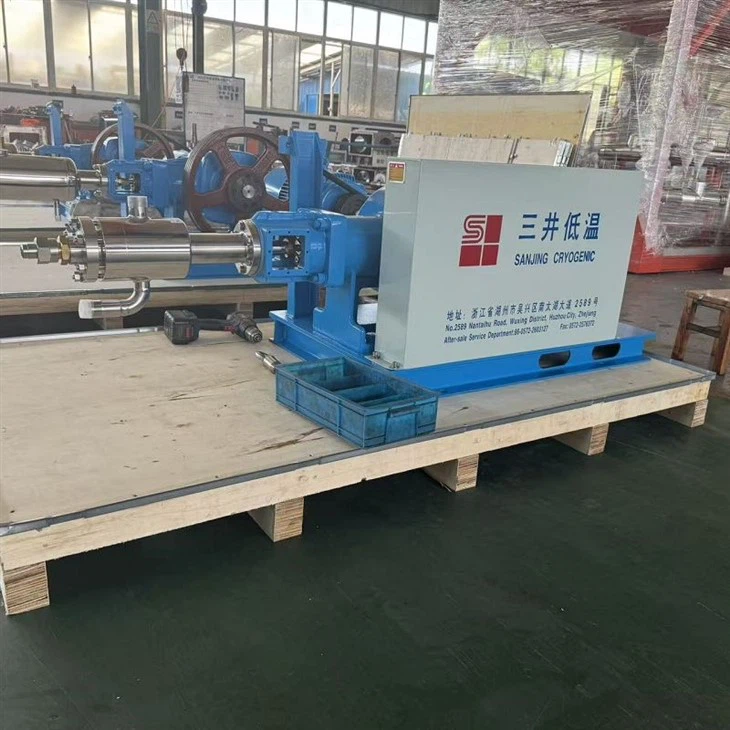
Maintenance is another factor. Reciprocating piston pumps have more moving parts compared to some other pump types. These moving parts require regular maintenance to ensure proper operation. In a firefighting situation, where time is of the essence, having a pump that needs frequent maintenance can be a drawback. A breakdown during a firefighting operation could be disastrous.
Let's take a look at some of the reciprocating piston pumps we offer that might be relevant to firefighting. We have the High Flow Rate Cryogenic Reciprocating Pump. Although it's designed for cryogenic applications, its high - flow - rate capabilities could potentially be adapted for firefighting in certain situations. It's built to handle large volumes of fluid, which is an important consideration in firefighting.
Our Carbon Dioxide Reciprocating Pump is another option. While it's mainly used for carbon dioxide transfer, the technology behind it can offer insights into high - pressure pumping. The design and engineering of this pump could inspire solutions for high - pressure water delivery in firefighting.
We also have the Small Flow Rate Cryogenic Reciprocating Pump. Although it has a small flow rate, it can be useful in specific firefighting scenarios, such as in small, confined spaces where a lower volume of water is needed.
In conclusion, reciprocating piston pumps have both pros and cons when it comes to firefighting applications. Their high - pressure capabilities and precise flow control are definite advantages, but the relatively lower flow rate and maintenance requirements are challenges that need to be addressed.
If you're in the firefighting industry and are considering using reciprocating piston pumps, we'd love to have a chat with you. We can discuss your specific needs and see if our pumps are the right fit for your operations. Whether it's a small - scale local fire department or a large - scale industrial firefighting team, we're here to help. Contact us to start a conversation about how our reciprocating piston pumps can be part of your firefighting solution.
References
- Pump Handbook, Karassik et al.
- Fire Protection Handbook, National Fire Protection Association


